|

Nondestructive Testing -
Program Overview
What is Nondestructive Testing?
“Nondestructive testing (NDT)…is testing that does not destroy
the test object. [NDT] is vital for constructing and maintaining all
types of components and structures. To detect different defects such
as cracking and corrosion, there are different methods of testing available,
such as X-ray (where cracks show up on the film) and ultrasound (where cracks
show up as an echo blip on the screen)…
“While destructive testing usually provides a more reliable assessment
of the state of the test object, destruction of the test object usually makes
this type of test more costly to the test object's owner than nondestructive
testing. Destructive
testing is also inappropriate in many circumstances, such as forensic investigation. That
there is a tradeoff between the cost of the test and its reliability favors
a strategy in which most test objects are inspected nondestructively…1”
Cowley’s Nondestructive Testing program provides tremendous opportunities
in safety & quality inspection. The NDT program offers an Associate
of Applied Science degree that is currently in high demand. NDT
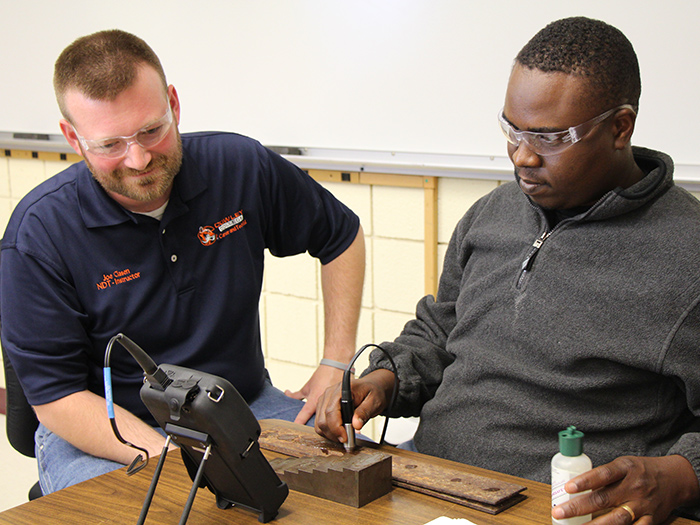
students develop the knowledge and skills required to perform sophisticated
testing techniques such as eddy current, x-ray, liquid dye penetrant,
magnetic particle, and ultrasonic testing that are currently required
in many different industry fields.
NDT technicians are in high demand. The basis of inspection technology
depends upon the technician’s ability to understand the principles
of physics and use fundamental mathematical calculations to locate flaws
in materials. Lives sometimes depend upon the ability of the technician
to understand and have adequate training in this area.
You will learn blueprint reading, basic
metallurgy, measurement, and proper use of equipment used in the various
NDT testing processes. Mid-level
mathematics, communication skills, writing, and understanding codes & procedures,
materials composure, and basic theories of economics are also integrated
into the program.
Upon completion of this program, students will be prepared to develop
and maintain quality control programs. Students will be trained
to set up and calibrate equipment, as well as interpret and evaluate
results based upon Nondestructive testing methods with respect to applicable
codes, standards, and specifications. Students will be prepared
for the American Society of Nondestructive Testing (ASNT) certification
examination.
Classes in Nondestructive Testing began at Cowley College in 1991. Aerospace
in Kansas and refining/oil production to the south in Oklahoma, created
an industrial need for an NDT inspection program. Our location
provides diverse industry support in the form of equipment, inspection
materials, and program technical direction.
Cowley College is an ideal setting for study. Arkansas
City is located at the confluence of the Arkansas and Walnut rivers and
provides students with a small-town experience. Class sizes have
a maximum student-teacher ratio of 18:1, allowing for personalized instruction
and an opportunity to build relationships.
New Technology
With the recent addition of a real-time x-ray system, digital film processing
system and several 3D-phased array ultrasonic instruments Cowley now
has some of the newest technology available in business and industry
today. This equipment will allow the student exposure into the
most current technology used in the NDT field.
Skills Required
NDT Technicians must possess blueprint reading, mathematical skills,
excellent communications skills, ability to interpret codes, and great
attention to detail.
Career Opportunities
Most NDT technicians review and provide quality assurance in a variety
of settings, which include but are not limited to:
Aviation
Construction
Manufacturing
Industrial Plants (Nuclear, Petrochemical, Power, Refineries, Fabrication
Shops, etc.)
Pipelines
Railways1
What Can I Earn in this Field?
Students graduating from the NDT program within the past five years (2002-2007)
have earned an average hourly wage of $15-$24/hour depending upon the
industry in which the student is employed. As with any industry,
the more skills and knowledge the student has the more valuable they
are to their company, creating higher pay for them.
Class Schedule
The Nondestructive Testing curriculum is offered as a two-year Associate
of Applied Science degree involving 66 credit hours—48 required
technical hours and 18 general education hours. The NDT curriculum
is designed to provide entry-level employment skills and knowledge
required by business and industry. Classes exceed requirements
recommended by the Society for Nondestructive Testing document TC 1-A for
classroom training.
Mission
Our mission is to develop knowledge, skills, and attitudes necessary
for students to succeed in a Nondestructive Testing Career.
Vision
Our vision is to provide students with more than a technical skill. Rather,
we will provide them the understanding of the need for life-long learning.

Take the Fast Track to an Associate of Applied Science
degree in Nondestructive Testing
Online Degree Completion
Cowley offers the only online AAS degree program for NDT in the world.
Completely online course work except for the final one - two weeks
for on-campus practical training.
Accelerated Program
Instead of the traditional two-year program, you can complete this degree
in 16 months. Degree requires 66 credit hours that include 48 required
technical hours and 18 general education hours.
Share Learning with a Cohort Group
A group of six to twelve students will start and complete the accelerated
NDT program as a unit. The schedule is defined for a methodical progression
through the core, technical courses for each cohort for each semester.
The courses are scheduled to ensure that the program will be completed
in 16 months.
For more information about the accelerated program, go to the online
college, NDT
accelerated program.
To enroll in the accelerated program,
contact the Career and Technical Education department. Call 620. 441.5279
or email clasenj@cowley.edu.
1. Nondestructive testing. (2008, May 29). In Wikipedia, The Free Encyclopedia.
Retrieved 15:54, June 10, 2008, from http://en.wikipedia.org/w/index.php?title=Nondestructive_testing&oldid=215667426
|