
Emergency Assistance Information
Need assistance now?
Emergency: Call 620-441-5599 or 5599 from any campus phone. If you are off campus, call 9-1-1.
Security Escort: Call 620-441-5599 or 5599 from any campus phone.
Locked yourself out? (dorm room, car, classroom): Call 620-441-5599 or 5599 from any campus phone.
Lost and Found: Public Safety Office in Kerr Tech Building, Room 111 at 115 S 2nd Street. Call 620-441-5599 to report a lost item.
Counseling: Find local and national resources.
Report an issue or concern: Report and learn more about reporting options.
Crisis Management at Cowley College
Cowley College is committed to being a disaster-resilient College where the safety and security of students, faculty, staff and visitors are a priority.
 Cowley College has a cross-functional Crisis Management Team that provides leadership,
guidance and support in emergency situations. Cowley has established policies and
procedures to respond to and recover from disasters and emergencies that affect the
campus community.
Cowley College has a cross-functional Crisis Management Team that provides leadership,
guidance and support in emergency situations. Cowley has established policies and
procedures to respond to and recover from disasters and emergencies that affect the
campus community.
Your Role as a Campus Community Member
As a member of the Cowley campus community, it is your duty to be alert to what is happening around you, to report any issues or emergencies that may arise and, in the event of an emergency, to cooperate with any directions or directives issued by Cowley College’s Crisis Management personnel.
How to Respond to Common Emergencies
Avoid, Deny, Defend
As a result of increased public awareness, many citizens have asked what individuals can do to protect themselves and reduce the dangers faced during one of these events. Avoid | Deny | Defend™ has been developed as an easy to remember method for individuals to follow – as we've seen that hiding and hoping is not an effective strategy.
Be Prepared
AVOID starts with your state of mind.
- Pay attention to your surroundings.
- Have an exit plan.
- Move away from the source of the threat as quickly as possible.
- The more distance and barriers between you and the threat, the better.
DENY when getting away is difficult or maybe impossible.
- Keep distance between you and the source.
- Create barriers to prevent or slow down a threat from getting to you.
- Turn the lights off.
- Remain out of sight and quiet by hiding behind large objects, and silence your phone.
DEFEND because you have the right to protect yourself.
- If you cannot Avoid or Deny, be prepared to defend yourself.
- Be aggressive and committed to your actions.
- Do not fight fairly. This is about survival.
Watch the Avoid, Deny, Defend, video on YouTube for an overview of how to save your life in an active attack event. Always remember, What You Do Matters.
Bomb Threats
All threats to the campus community are to be taken seriously. If you receive a telephone call informing you that a bomb has been placed on campus, do the following:
- Remain calm and refer to the following Bomb Threat checklist to record information the caller provides to help determine the seriousness of the threat and possibly identify the caller.
- Keep the caller on the line as long as possible to attempt to gather as much information as possible.
- Call Cowley College’s Public Safety Department at ext. 5599 or 620-441-5599 immediately for further assistance.
- If the bomb threat was left on your voicemail, do not erase the message.
The decision of whether or not to evacuate a work area or building will be determined by the Public Safety Department and the administration after a thorough evaluation of the information available. This decision will be communicated quickly to personnel.
If the evacuation is called for, do not use cellphones or radios within 300 feet of the area.
Check for but do not disturb unusual objects as you leave a classroom or office. Report any unusual objects to the Public Safety Departments.
Pathogen Exposure
Immediate first aid
- Cuts and punctures: Wash thoroughly with soap and water.
- Splashes to mouth, nose, or skin: Flush the area with plenty of water.
- Eye splashes: Flush eyes with clean water, saline, or a sterile eyewash solution. Use an eyewash station in areas where one is available.
Reporting and follow-up
- Report the incident: Immediately notify your instructor, supervisor, or Public Safety.
- Seek medical attention: Get a medical evaluation promptly to assess the risk and discuss potential post-exposure prophylaxis (PEP).
- Complete paperwork: Fill out any necessary incident reports as required or directed.
Cleanup procedures for spills
- Wear PPE: Use gloves and eye protection. Wear an impervious apron if splashing is expected.
- Remove visible material: Use disposable towels to clean up the spill.
- Disinfect the area: Use an approved germicide or a bleach solution (e.g., 1:10 dilution of water and bleach).
- Dispose of waste: Place all contaminated materials in a biohazard bag, seal it, and then place it in a second bag if a red biohazard bag is not available. Dispose of in accordance with facility guidelines.
- Wash your hands: Wash your hands with soap and water after cleanup.
Earthquake
For every earthquake where things are moving or falling, DROP, COVER, and HOLD ON! Get to the ground under something and cover your head in particular.
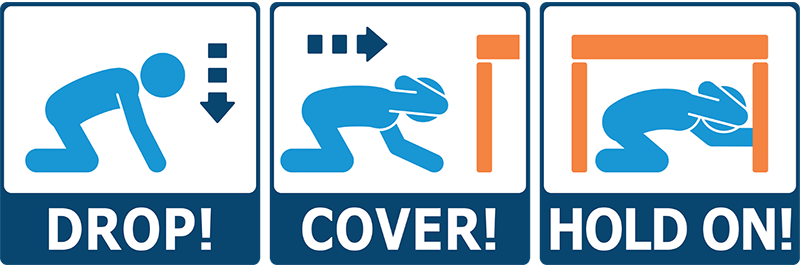
- Minor earthquakes should not prompt you to evacuate. Unless there is another reason to leave the building, you are safer inside than outside after an earthquake.
- However, if you are ordered or required to evacuate, follow instruction from the Public Safety Department or emergency authorities.
- If you are unsure and you believe that evacuation is necessary for your safety, it is recommended to wait for the shaking to stop, then carefully leave the building and move at least 50 feet away to an open area.
- Do not run while the building is shaking, this is how people can get seriously injured.
Elevator Malfunction
If you become trapped in an elevator:
- Activate the elevator emergency phone, which places a call to Public Safety, or dial 620-441-5599 from a cellphone.
- Remain calm. Assist others in staying calm and wait for help to arrive.
- Do not try to force open an elevator door.
- Do not crawl out of an elevator without assistance from authorized personnel.
If you are not in need but hear a problem or person in need of help:
- Dial ext.5599 from any campus phone or call 620-441-5599 to notify Public Safety and report the following information:
- Name of the building, your name and cellphone number (if applicable)
- Your location within the building
- Where the problem is (what building room number, floor level, etc.), if known.
- Whether a medical emergency exists.
- Try to keep the person(s) in need calm and wait for help to arrive.
Spills or unusual odors
In the event of a chemical spill or unusual odor and for assistance with the proper disposal hazardous waste:
- Promptly notify Public Safety at 5599 or 620-441-5599. They will coordinate with the Director of Campus Facilities and the Custodial Services Supervisor the response, clean-up and disposal efforts. If an emergency exists, the Fire Department may also be contacted.
- Be sure to secure the area to ensure that no one else is exposed.
- Safety Data Sheet information is located within each building.
Suspicious Mail or Packages
It is important that every employee handling or receiving mail can identify a suspicious letter or parcel. Although occurrences are extremely rare, it is crucial to know what to do when suspicious mail is received. Remain alert for signs of potentially dangerous mail and packages.
If you receive suspicious mail or package:
- Do not handle.
- Isolate it and secure the area.
- Contact Public Safety at Ext.5599 or 620-441-5599.
- Alert others nearby to relocate to an area away from the site of the suspicious item.
- Do not open, smell or taste the suspicious item.
If you suspect the mail or package contains a bomb (explosive) or radiological, biological, or chemical threat:
- Isolate the area immediately. Do not touch or move the package. If possible, close the door to the room and prevent others from entering.
- Move yourself and others away from the immediate area and go to a safe location.
- Call Ext.5599 or 620-441-5599: Make the call from a safe distance. Do not use a cell phone or two-way radio to call if you suspect a bomb, as this could be a detonator. Use a landline if available.
- If you have come into contact with the package, wash your hands thoroughly with soap and water to prevent spreading any potential substance.
How to recognize suspicious packages and mail:
- Excessive postage, no postage, or misspelled common words
- No return address or strange return address
- Unusual addressing, such as not being addressed to a specific person or the use of incorrect titles or titles with no name
- Restrictive markings, such as “personal,” “confidential” or “do not X-ray”
- Powdery substances felt through or appearing on the item
- Oily stains or discolorations on the exterior
- Strange odors
- Excessive packaging materials, like tape or string
- Lopsided or bulky shape of envelopes or boxes
- Ticking sounds, protruding wires or exposed aluminum foil
Evacuations
- Learn and know the emergency exits for your building(s). If you discover fire and/or smoke, pull the nearest fire alarm and quickly exit the building.
- Notify Public Safety at Ext.5599 or 620-441-5599. If you are at an off-campus location, dial 9-1-1.
- If you hear or see an explosion, exit the area as safely as possible.
Building Evacuations
Whenever the fire alarms and/or sprinkler systems are activated, follow these directions:
- All occupants of the building must promptly and calmly evacuate using the nearest exit and report to the designated Meeting Location destinations.
- Do not use elevators!
- Be aware of others in your area (or those you are responsible for) and inform them to evacuate as well. Assist persons with disabilities.
- Follow directions given by Building Safety Captains (BCS).
- In the event that you encounter smoke and/or fire while evacuating, exercise caution and logic to help ensure your safety and the safety of others. Remember, “Stay Low and Go!”
- Once gathered at the evacuation meeting location, take a head count to ensure that everyone is safely out of the building. Report any persons remaining in the building or missing.
Public Safety will respond to the affected building to determine the location of the smoke/fire/explosion.
The Fire Department is notified for all fire alarms. If no source of smoke/fire is located, the occupants will be given an “all clear” to return to the building by Public Safety or Fire Department personnel.
Remember:
Persons needing evacuation assistance should establish procedures in advance with their instructor or supervisor. Students should contact Accessibility Coordinator (ext.5557) and employees should contact Human Resources (ext. 5214). The Public Safety Department is available for consultation on these procedures.
- Do not return to the building until Public Safety or Fire Department personnel informs you that it is safe to do so.
- Do not use the elevator to evacuate the building during a fire alarm. Use the nearest stairwell.
- Evacuate the building anytime the fire alarm/or sprinkler system is activated. Do not wait or assume it is a drill or false alarm.
Assisting the Disabled
- Be aware of disabled employees/students in your area.
- Evacuation plans should be made in advance the Accessibility Coordinator or Human Resources.
- The fire department recommends moving a disabled person to another connected building or inside an enclosed stairwell or safe area of the building until help arrives – lateral evacuation to another building if possible. Communication is key. Report all persons with ‘evacuation’ plans or alternate emergency locations to your BSC or Public Safety personnel and make their whereabouts known.
- Do not attempt to move a disabled person down a flight of stairs and risk injuring that person or yourself. Let the professionals take charge.
Medical Attention
Whenever a person is injured or becomes ill, promptly ensure the individual receives the appropriate medical attention:
- If the injury/illness is serious or life-threatening, call 9-1-1 and then immediately notify Public Safety at ext. 5599 or 620-441-5599. If you are at off-campus location, dial 9-1-1.
- Do not move the person unless it is necessary for to secure them from further safety issues.
- Protect the person from unnecessary manipulation and disturbance.
- To the extent that you are trained, begin CPR and other first aid measures as appropriate. Retrieve the nearest Automatic External Defibrillator (AED). See AED locations here.
- Stay with the person until advanced medical assistance arrives.
- If the injury/illness is not serious or life threatening, ask the person what assistance is needed.
Also contact Public Safety at ext.5599 from a campus phone or 620-441-5599 from any phone to assist to the extent requested by the affected individual.
What to Do IF You’re Injured at Work:
- Ask: IS the injury serious or life-threatening?
- Report the incident your supervisor.
- Seek medical treatment if necessary.
- Follow-up as directed by a medical professional.
Remember to report any on-the-job injury ASAP to be considered for worker’s comp benefits.
Employees who suffer and on-the-job injury/illness should remember the following:
- Regardless of the severity, promptly report all on-the-job injuries to HR and/or Public Safety.
- If an injury involves a threat to life or limb, contact Public Safety to coordinate emergency medical treatment.
- Although some on-the-job injuries may not require medical attention, always report all on-the-job injuries in the event you need medical treatment at a later date.
Procedures For Infectious Disease
Administrative Procedure
(Reference BP184.00 BLOODBORNE PATHOGENS EXPOSURE CONTROL)
This administrative procedure is for employees and/or students who acquire a communicable disease or a life-threatening illness, which may affect their health, safety, welfare, and that of others with whom they have contact.
Reporting Suspected Communicable Diseases
Employees and students should report suspected cases of communicable disease to the following College personnel. If the first contact is not available, contact the next person/department in the order listed.
1. Public Safety Department – 620-441-5599 or security@cowley.edu
2. Director of Public Safety – 620-660-5010 or matt.stone@cowley.edu
3. Vice President for Student Affairs – 620-442-5206 or jason.kegler@cowley.edu
Power Outage – Electricity
Report to Public Safety at ext.5599 or 620-441-5599
Remain calm. Stay where you are unless you are in an unlit area. If you are in an unlit area, proceed cautiously to an area that has emergency lighting or is lit from daytime window lighting. Provide assistance to others in your immediate area who may be unfamiliar with the space. It is recommended to use a cellphone flashlight feature as an aid during the outage.
Many electrical power interruptions are brief. Unless there is some other danger, it is not necessary to evacuate or dismiss students unless instructed to do so. In most cases, power will be restored or classes will soon be relocated to another area with power, or possibly dismissed if the outage continues.
Water Service Interruptions/Other
Report all situations to Public Safety at ext. 5599 or 620-441-5599. They will then coordinate with Campus Facilities personnel.
Water may enter a building from any of the following sources:
- Breaks or leaks in a water line
- Rain water/flooding
- Sewer leaks/backups
- Condensation from uninsulated piping
Natural Gas Odors
- Report to Public Safety at ext.5599 or 620-441-5599 to coordinate with Campus Facilities personnel and other authorities if needed.
- If there are concerns or if evacuation is deemed necessary, direct all occupants to leave the building and proceed to the designated evacuation meeting location.
- While exiting the building, do not use fire alarm pull stations, refrain from telephone use, hand-held radios, or electrical switches.
- Report any medical concerns to Public Safety.
- Remain in assembly area until released by Public Safety.
Severe Weather
Before severe weather:
- Sign up for campus notifications to receive text messages, push notifications, and/or emails about significant campus events or severe weather.
- Familiarize yourself with emergency plans, evacuation routes, and shelter locations.
- Signs will be posted around campus when severe weather is possible for the day.
- Building Safety Captains (BSC’s) will be notified.
- Continue with your daily routine; remain alert to the possibility of severe weather and be prepared.
If a Tornado Warning is issued for our area, the following will occur:
- All mass communication methods (text, phone calls, emails, push notifications, as well as post made to the college website and social channels) will be made simultaneously.
- Move immediately to the designated area and shelter-in-place.
- Remember to D.U.C.K. during a tornado
- Down to the lowest level or to the designated shelter location area.
- Under something sturdy
- Cover your head
- Keep in shelter until the storm passes and the warning expiration message is issued.
- Stay away from windows and exterior doors.
- BSC’s will monitor their areas to assist with sheltering.
Note: If the facility is damaged, evacuate the area after the storm passes (following direction of building emergency personnel) and stay clear of the damaged area. Be aware of fallen debris, downed power lines, and gas leaks. Report any injuries by calling ext. 5599 or 620-441-5599.
Winter Weather Closings
You can find out if the college is closed due to inclement weather in one of these ways:
- The announcement will be posted on the home page of the College’s website, www.cowley.edu.
- Students, faculty, and staff that have downloaded the LiveSafe mobile safety app or that have signed up for BlackBoard Connect will receive text, push notification, and/or an email automatically in the event of an emergency or weather closing.
- The announcement will be posted on the College’s social media pages:
- Closing and delayed start announcements will also be shared with local news media fir dissemination.
Note that it can take awhile for an announcement to appear on television, so you are encouraged to use one of the other methods as your primary source of information.
Students, please check with your instructors for details and the possibility of remote class during a weather-related closure.
Emergency Phones
In addition to using the LiveSafe mobile safety app to call or notify the Public Safety Department, you can use the nearest exterior emergency phone to report an emergency on campus grounds or parking areas.
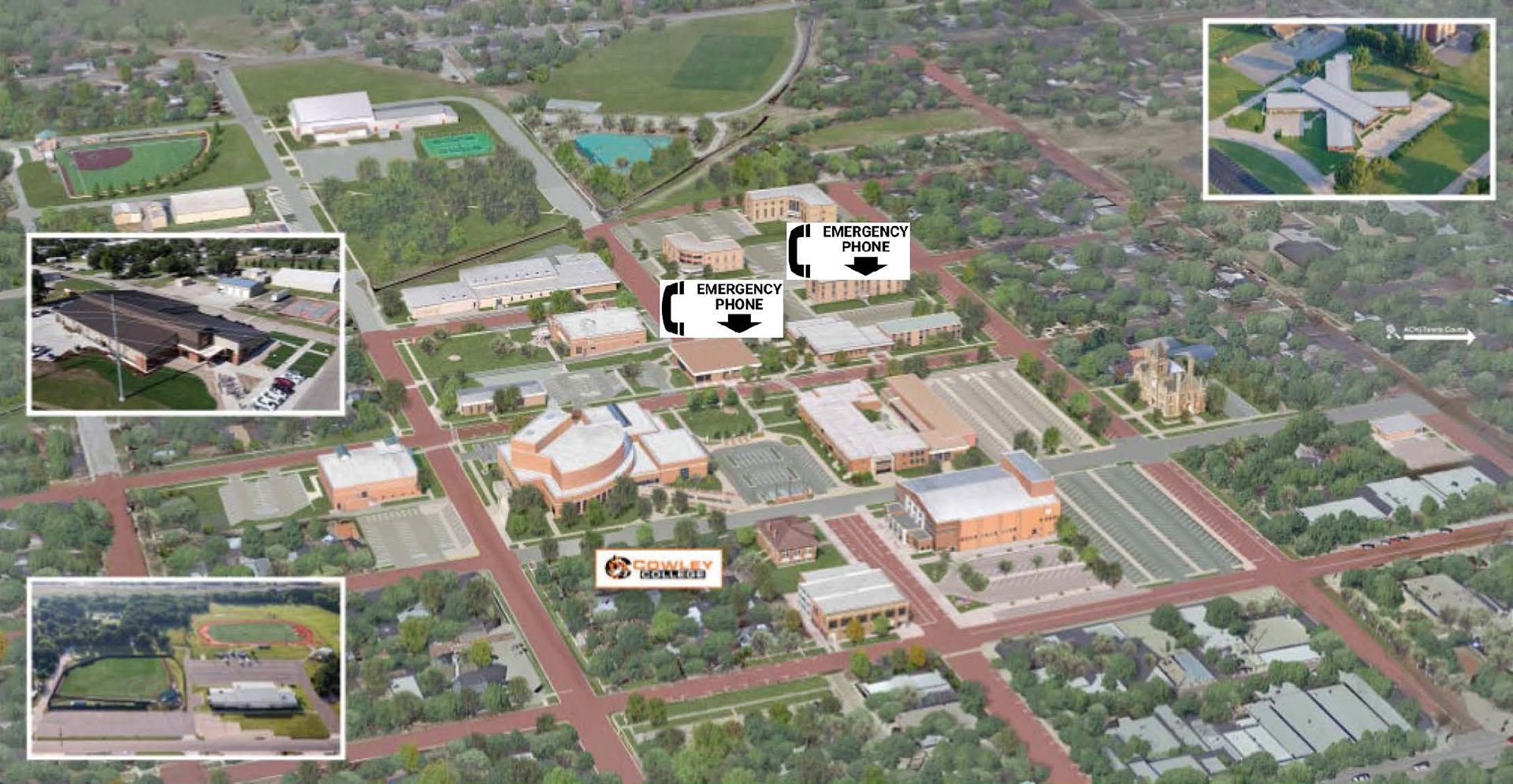
See the map below for emergency phone locations for the main campus.
Emergency Phones
There two emergency phones located on the main campus. There is one located on the on the west side of the north entrance on the Renn Memorial Library. The other is located on the north side of the east entrance on Kirke-Dale dormitory.
When you call, give your name, telephone number and location, and the nature of the call.
Do not hang up until the person answering the call ends the conversation.
Non-emergency calls
If you need public safety assistance but there is no emergency, call ext. 5599 from a campus phone or 620-441-5599 from a cellphone.
All media inquiries should be directed to the Director of Marketing and Strategic Communications at 620-441-6503.
LiveSafe App
Each campus community member is strongly encouraged to have the LiveSafe mobile safety app on their cellphone which essentially puts an emergency phone in the palm of your hand.
Important Cowley College Contact Information
- Campus Emergencies: ext 5599 or 620-441-5599
- Emergencies off-campus: Call 911
- Campus non-emergencies: ext 5599 or 620-441-5599
- Cowley College Main Line: 620-442-0430
- Accessibility Services: 620-441-5557
- Counseling Services: 620-441-5228
- Campus Facilities (maintenance, custodial, grounds): 620-441-5299
- Technical Support: helpdesk@cowleyedu
- Employee Assistance Program: 800-234-0630
- Worker's Compensation Treatment Centers
- Main Campus: 620-442-2100
- Wichita Clinic: 316-689-9111
- Mulvane Family Medical Center: 316-777-0176
- Sumner County Family Care: 620-326-3301
Important Local, State & National Phone Numbers
- Behavioral Health Crisis Services: 800-499-1748
- County Health Department
- Cowley: 620-441-3260 or 620-221-1430
- Sumner: 620-326-2774
- Sedgwick: 316-660-5555
- Mental Health Center
- Cowley: 620-221-9664
- Sumner: 620-326-7448
- Sedgwick: 316-660-7500
- Police/Fire/EMS: Call 911
- Dispatch (Non-emergency)
- Cowley: 620-441-4547 or 620-221-5447
- Sumner: 620-326-2884
- Sedgwick: 316-660-4977
- Kansas Coalition Against Sexual and Domestic Violence: 888-363-2287
- National Helpline (Alcohol & Substance Abuse/Mental Health): 800-662-4357
- RAINN National Sexual Assault Hotline: 800-656-4673
- Road Conditions for Kansas: 866-511-5368
- National Child Abuse Hotline: 800-422-4453
- National Runaway Hotline: 800-786-2929
- 988 National Suicide Prevention Hotline: Call 988 or 800-273-8255
- Domestic Violence Hotline: 800-799-7233
- RAINN National Sexual Abuse Hotline: 800-656-4673
Be safe, be ready with CC’s Mobile Safety App LiveSafe
Download the LiveSafe mobile safety app on your smartphone or smart device. You can quickly contact help in an emergency with one-touch dialing to CC Public Safety and 911. Two-way communication via chat with CC Public Safety. You may also report anonymously through the app safety tips and concerns.
Defibrillator & Kit Locations
AED and Naloxone (Narcan) kit locations
Automated External Defibrillators are strategically located on the Main campus and at all off-campus locations.
A Naloxone (Narcan) kit is co-located within each AED kit on campus.
AED locations at Cowley College
| Campus | Facility | Location |
|---|---|---|
| Main Campus |
Wellness Center |
Located in Free-weight Room on east wall |
|
Scott Auditorium (4) |
Located in west foyer area and training room |
|
|
Brown Center |
Located in upper-level foyer near handicap entrance |
|
|
Kimmell Dorm |
Located in main lobby near elevator |
|
|
Kirke-Dale Dorm |
Located in main lobby near manager’s apartment |
|
|
Public Safety Office |
Portable AED for responding |
|
|
Lodge Dorm |
Located in main lobby on south wall |
|
|
Hargrove Athletic Center |
Located in SW corner of gym floor |
|
|
Hafner Training Center |
Located in connection area between main field & batting cages |
|
|
Tiger Baseball Park |
Located inside the press box |
|
|
Hargrove Softball Field |
Located inside the press box |
|
|
T&F/Soccer Complex |
Located inside the Gate/Concession Booth |
|
| Mulvane |
SEA Center |
Located in hallway near admissions |
|
Tech Education Center |
Located in hallway between classrooms |
|
| Wichita |
Wichita Center |
Located in computer lab area |
| Sumner |
Short Building |
Located in the Short Building outside the admissions area |
Behavioral Intervention Team (B.I.T.)
The Cowley College Behavioral Intervention Team (BIT) was established in 2014. In 2022, the Behavioral Intervention Team (BIT) was further enhanced through a partnership with the National Threat Assessment Center (NTAC), a division of the United States Secret Service.
This partnership strengthened the BIT’s ability to:
- Implement evidence-based threat assessment practices
- Improve early identification of individuals at risk of harming themselves or others
- Enhance training for staff on behavioral threat assessment and management
- Align protocols with national best practices in targeted violence prevention
NTAC is nationally recognized for its research and guidance on preventing targeted violence, particularly in schools, workplaces, and public institutions. By collaborating with NTAC, the BIT expanded its capacity to proactively assess, manage, and mitigate potential threats through structured, research-supported approaches.
Mission Statement
The mission of the Cowley College Behavioral Intervention Team (BIT) is to protect the mental health and well-being of students, faculty, and staff of Cowley College, to ensure the safety of our stakeholders, to provide equality and biased free decision making with no regard for race, gender, religion, academic or athletic status, and to provide needed services, support, and guidance for both the students and the college in times of crisis.
The following will be accomplished through the following values:
Compassion
The needs of all parties concerned will be taken care of with the highest regard for
everyone involved
Integrity
All matters will be handled with honesty and confidentiality with as complete of a
fact base as possible.
Safety
The security, safety, and well-being of all stakeholders will be at the forefront
of all issues. The needs of the individual and the needs of the institution will be
balanced at all times.
Equality
Equal treatment will be ensured for all involved regardless of ethnicity, gender,
religion, academic or athletic status through cross-sectional and multi-disciplined
fact review and decision making
Purpose
BIT ensures aid and support is extended to students and families in need, while also
identifying and resolving issues that would otherwise interrupt the normal activities
of the College.
Goals
- Engage in risk reduction through assessment of circumstances as reported through various reporting mechanisms.
- Identify persons who have shown a risk of harm toward others or themselves.
- Recommend an action plan to mitigate any threat or potential danger to people or any College assets.
- Centralize information concerning inappropriate behavior and initiate appropriate action(s) in response to potential threats.
- Communicate with professional authorities when the scope of the threat is beyond BIT’s scope.
Team Membership
The Behavioral Intervention Team (BIT) is comprised of college personnel with expertise in working with individuals in distress, law enforcement and threat assessment applications, college operations, medical and mental health services, emergency management, and student success.
While specific names and titles may change, the core team composition includes:
- Vice President of Academic Affairs
- Executive Director of Student Services
- Student Life Counselor
- Director of Public Safety
- Director of Criminal Justice
- Director of Housing
- Accessibility Coordinator
- Director of Student Enrollment and Success
- Admissions Coordinator
- Assistant Athletic Director
- Faculty Representative
This multidisciplinary structure ensures a coordinated, informed, and proactive approach to identifying, assessing, and managing behaviors of concern within the campus community.
Meetings and Response Protocol
The Behavioral Intervention Team (BIT) meets regularly on a biweekly basis to review new reports, assess emerging concerns, and discuss follow-up actions related to prior incidents. These meetings ensure ongoing monitoring, coordinated intervention strategies, and continuity of care and response.
In situations involving an imminent threat or urgent concern, BIT members may be convened immediately to assess the situation, determine appropriate actions, and implement timely interventions to support the safety and well-being of the campus community.
Depending on the situation, personnel with areas of specialization or responsibility, or those who have vital information, may be called upon to assist the team.
Emergency Notifications System
Cowley College places the security and safety of its students, employees and visitors as its highest priority. To keep you informed in emergency situations, the College has developed a comprehensive emergency notification system. The emergency notification system includes several methods of communication.
Alertus
Alertus is Cowley College’s emergency notification system. It allows the College to communicate emergency information via text and email quickly to students, faculty, staff, and other pre-designated individuals. All students and employees are strongly encouraged to sign up for emergency notifications.
LiveSafe safety app
Download the LiveSafe mobile safety app to your smartphone or other smart device. Receive push notifications of emergency situations affecting the campus community by installing this app. You can also quickly contact help in an emergency with easy-access dialing to CC’s Public Safety Department or 911.
BlackBoard Connect
Sign up for BlackBoard Connect to receive alert messages via email, text message, and/or voice message, so you can be notified of emergency events, campus closures, weather developments, and other critical notifications provided by the College.
Emergency Response Intercom System (E.R.I.S.)
Emergency alerts may be announced over an audible system of speakers on each campus location to advise of the situation and protective measures to take.
Social Media
The College most post on its official Facebook and X sites to inform followers of an emergency.
Desktop Computer Alert
An emergency alert message may appear on all College network computers in labs, classrooms, and work areas announcing an emergency and protective measures to take.
Cowley College website homepage
An alert banner may appear at the top on the front page of CC’s website pages.
Local media outlets
The College may use local media to inform the community of an emergency as needed.
Who handles emergencies at CC?
CC Public Safety Department
CC’s Public Safety Department, located in the Nelson Student Center, provides service 24 hours a day. It is an integral part of the college’s dedication to developing and maintaining a safe and secure campus through the cooperative efforts of many college departments.
The department is comprised of (6) full-time Public Safety Officers with over 100+ years of experience. We also have two part-time Public Safety Officers that assist with various duties. Public Safety Officers patrol the campus and offer a variety of safety and security services seven days a week. They also function as first responders for fire, medical, and campus emergencies, as they are trained in first aid, CPR, and AED response. Additionally, the Criminal Justice Department provides assistance for campus events with our Student Patrol program.
Building Safety Captain Program
Under the College Crisis Management Plan, each building has designated Building Safety Captains (BSCs) dedicated to assisting during an emergency response.
The BSC’s play a critical role in the overall safety of the building occupants and in communication to all staff and students during an emergency.
The role of a Building Safety Captain is to:
- Oversee the building emergency plan for their assigned facility/area, and monitor for potential threats
- Provide instruction and training of emergency information to building occupants
- Act as a communication liaison to the incident Commander or Public Safety
- Maintain employee listings/student rosters
Weapons Policy
Concealed Carry Summary
Our policy:
- Cowley College recognizes the right of authorized individuals to carry concealed handguns, in accordance with Federal and State laws and regulations. The full policy is available in Cowley College's 126.00 Weapons Policy.
Who can carry?
Individuals who are at least 21 years of age or possess a valid provisional license issued under state law or a valid license or permit to carry a concealed firearm issued by another jurisdiction and recognized in Kansas, and who are in lawful possession of a handgun in accordance with Federal and State laws and regulations, may conceal carry.
What can be carried?
A handgun that is fully concealed.
Violation:
Partially or fully visible handguns do not meet the requirements of concealed carry. These offenses are violation of policy and should be reported immediately.
Where to report violations?
To the CC Public Safety Office at 620-441-5599.
Storing of handgun/weapons:
A handgun must be concealed and maintained on or about the person while on campus, unless it is secured in a locked, private vehicle and not visible from outside the vehicle. A handgun may not be stored in an office, a work area, an unattended backpack or carrier, or in any college locker.
Open carry remains prohibited inside any College facility or building.